
World War II remains a significant chapter in the history of our city and nation. This tragic period of the 20th century is one we must remember, passing down the stories of past events to future generations. Among those who deserve special recognition are the heroes who sacrificed their lives to bring peace to our country. Today, we recount the story of Arthur Louis Aaron, a Royal Air Force (RAF) pilot who flew 90 operational hours and completed 19 missions. He was awarded the Distinguished Flying Medal and, posthumously, the Victoria Cross. Next on leedsyes.com.
Education and Early Life
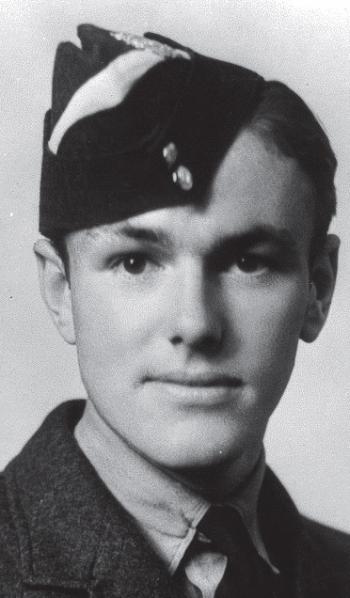
Arthur Aaron was born in Leeds in 1922. He received his education at Roundhay School and the Leeds School of Architecture.
In 1939, when World War II broke out, Aaron joined the University of Leeds Air Squadron. A year later, he trained as an RAF aircrew member, studying to become a pilot at No. 1 British Flying Training School in the United States. Aaron trained at Terrell Municipal Airport for nearly a year and returned to England in September 1941. He then undertook operational conversion training in England and joined the No. 218 Squadron of the RAF, piloting heavy bombers such as the Short Stirling.
The Challenges of a Pilot
Aaron’s first operational mission was a mine-laying operation in the Bay of Biscay. He later flew numerous missions over Germany. On one occasion, his Stirling bomber sustained significant damage during a mission, but Aaron successfully completed the bombing run and returned to England. For his bravery and success, he was awarded the Distinguished Flying Medal.
On the night of August 12, 1943, Aaron was captain and pilot of a Stirling bomber assigned to a raid on Turin. However, the aircraft was severely damaged by enemy fire: three engines were struck, the windscreen shattered, and the front and rear turrets were disabled. The altitude control system was compromised, making the bomber extremely difficult to fly. Tragically, the navigator was killed, and other crew members, including Aaron himself, were injured.
Aaron suffered a broken jaw, lung injuries, and a severely damaged right arm, rendering him unable to speak or use his right hand. Despite his injuries, he used hand signals to guide the crew and even attempted to take control of the bomber to maintain course. Weak from his injuries, Aaron resorted to writing instructions with his left hand to assist the crew. Landing the damaged aircraft in darkness was an arduous task, requiring multiple attempts. Ultimately, the crew managed to land the bomber using the bomb aimer’s station.
Nine hours after landing, Aaron succumbed to exhaustion. Medical professionals believed he could have survived if he had rested after his injuries, but Aaron chose to continue aiding his crew and ensuring the safety of the aircraft.
In the main hall of Roundhay School in Leeds, a memorial plaque commemorates Arthur Aaron and his heroic actions.
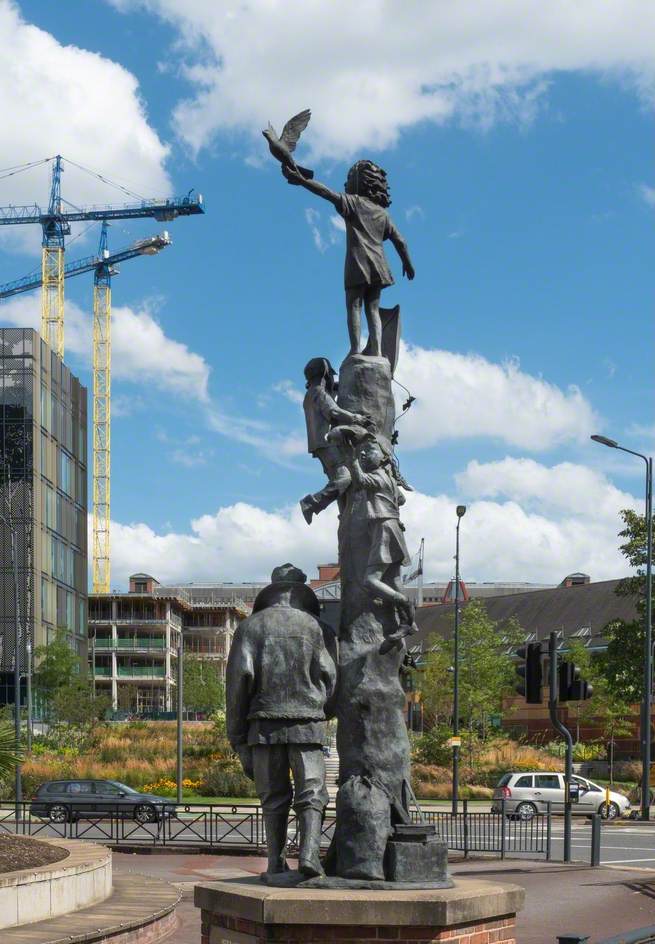
Additionally, a statue of Aaron was erected at a roundabout on the eastern edge of Leeds city centre near the West Yorkshire Playhouse. Unveiled on March 24, 2001, the statue was inaugurated by Malcolm Mitchem, the last surviving member of Aaron’s crew.
Arthur Louis Aaron’s story is a powerful reminder of the sacrifices made during World War II. His selflessness and courage saved his crew and ensured the safe landing of their aircraft.
We hope this story has provided valuable insight into our city’s history and the heroism of those who defended our country during World War II.
Do you know of any other wartime acts of heroism by our fellow townspeople? Share your stories in the comments—we’d love to hear from you.