
War is the worst event a nation can endure. While political leaders wage their conflicts, civilians—children, women, and the elderly—bear the brunt of the suffering. When such conflicts engulf the entire world, the devastation reaches unimaginable scales. The Second World War affected dozens of countries, claiming millions of lives. Leeds was not spared, as it experienced nine air raids known as the Leeds Blitz. Next on leedsyes.com.
Strategic Importance of Leeds
Although most of the fighting in World War II occurred in the Soviet Union and other countries, Britain was not untouched. Leeds became a target for Nazi bombings in March 1941 due to its strategic importance. At the time, Leeds was a major industrial city, home to significant economic, administrative, and industrial centers, as well as a vital railway hub.
Leeds housed key wartime industries, including Avro at RAF Yeadon, which manufactured Lancaster bombers, Kirkstall Forge, Barnbow munitions works, and ROF Thorp Arch near Wetherby. Many local businesses adapted to meet wartime demands, and the city constructed air-raid shelters and bunkers, preparing for the worst. The Nazis aimed to disrupt Leeds’ resources to weaken Britain’s war effort.
The Leeds Blitz
On the night of March 14, 1941, Leeds faced a devastating bombing raid. A total of 40 bombers targeted the city, part of a broader attack involving 451 bombers across the country that night. The attack focused on key city landmarks, including Leeds Town Hall, the City Museum, Leeds New Station, Kirkgate Markets, Quarry Hill Flats, Metropole Hotel, and the central post office.
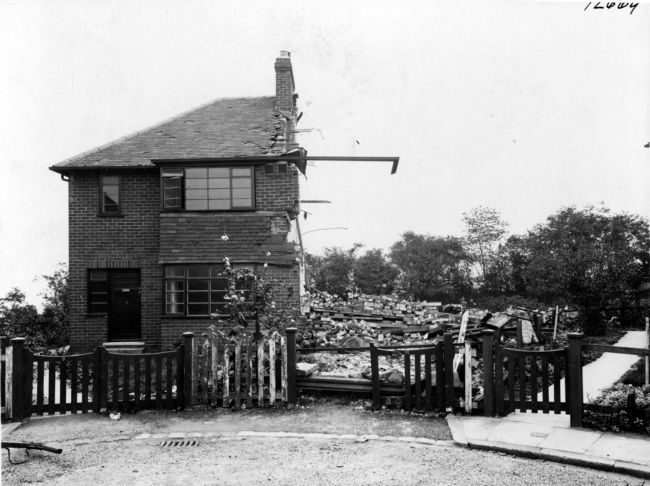
The raid resulted in over 100 buildings destroyed and claimed 65 lives. Over two nights of bombings, 25 tons of explosives were dropped on the city.
The cultural sphere of Leeds also suffered. The Leeds City Museum was heavily damaged, and many historical artifacts and the museum’s façade were destroyed. The bombing affected areas such as the city center, Beeston, Bramley, and Armley.
Bombing of Other British Cities
The devastation of Leeds was part of a broader campaign of Nazi air raids across Britain.
The London Blitz stands as one of the most harrowing episodes in British history. The bombings lasted for 57 consecutive nights, resulting in the deaths of over 40,000 civilians.
The Blitz began on the night of August 25, 1940, when ten German planes accidentally bombed London. In retaliation, British forces launched seven raids on Berlin over two weeks. The Nazis responded with their own Blitz, starting on September 7, 1940, and continuing until November 13, 1940.
On the first night alone, 300 bombers attacked London, followed by 250 more overnight. The September bombings claimed 430 lives. By the end of that month, 6,224 tons of bombs had been dropped on London.
Key dates of the London Blitz include:
- December 29, 1940: The heaviest raid on London’s City district, killing 8,000 people.
- May 10, 1941: The final major raid, leaving 3,000 dead or injured.
Following these raids, Hitler redirected his forces to the Soviet Union, sparing Britain further assaults on the same scale.
The Liverpool Blitz
Liverpool also endured heavy bombings during World War II. On the night of August 28, 1940, the first major raid took place, with the city facing additional attacks over the following three nights.
Over the next year, Liverpool suffered 50 bombings. The heaviest raids occurred on November 28 and in late December 1940, killing 160 and 365 people, respectively.
In May 1941, Liverpool faced its own week-long Blitz. Luftwaffe bombers dropped 2,315 high-explosive bombs and 119 other explosive devices over seven nights, with 681 aircraft participating in the assault.
The Leeds Blitz, like the broader destruction across Britain, serves as a stark reminder of the horrors of war. This war claimed millions of lives, destroyed homes, cities, and industries. While infrastructure and economies can be rebuilt, the loss of human life is irreparable—a tragedy that policymakers often overlook in their pursuit of conflict.
We hope this account has offered valuable insights into Leeds’ wartime history and prompted reflection on the human cost of war.